
The Hand on Every Door – Xabia Old Town
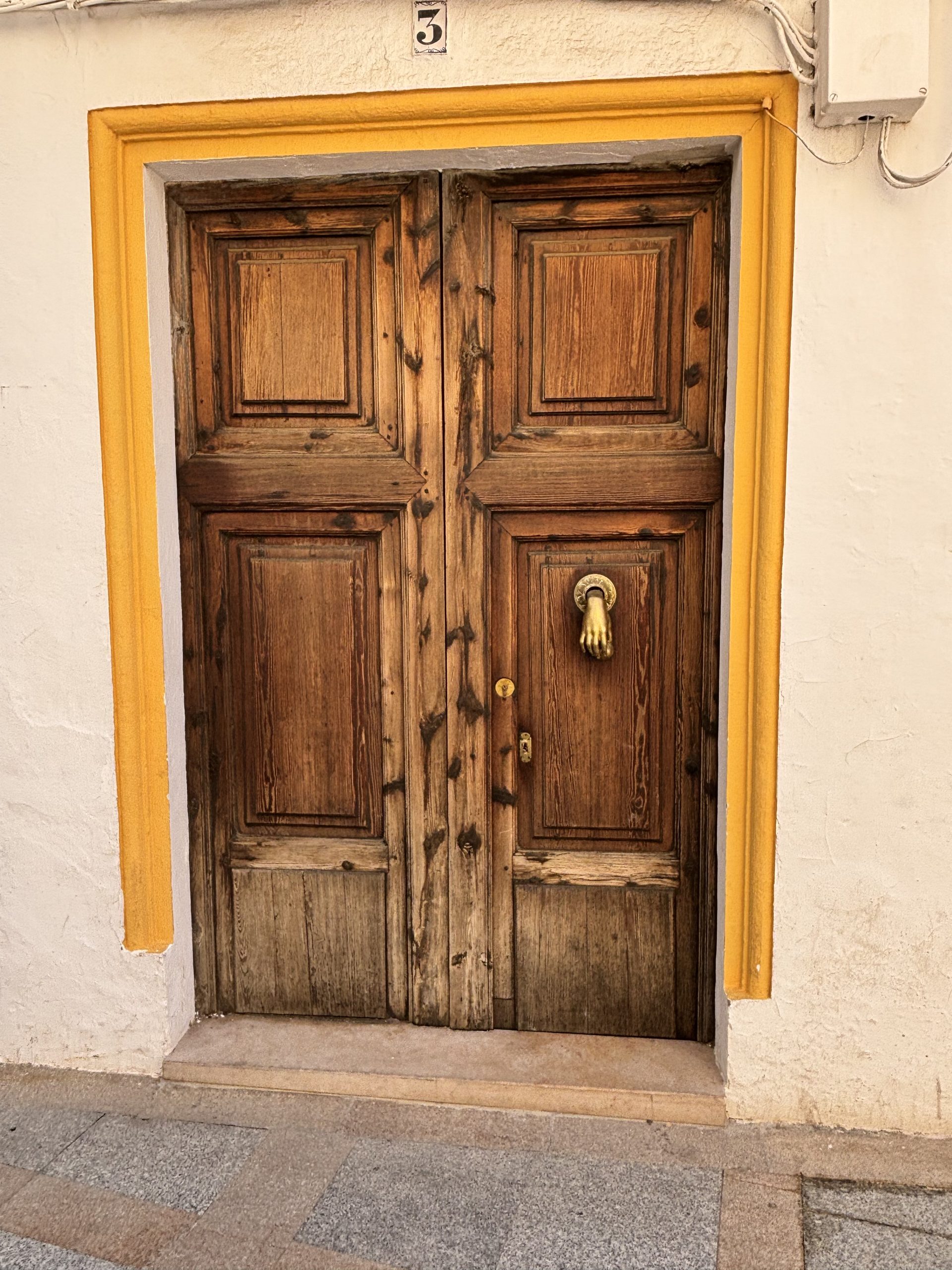
The hand on a door means something. It always has done. Before it was a door knocker it was a symbol of protection, of authority, of the household behind the door being under someone’s care. The mechanism came later. The symbolism came first.
The Romans put hands on doors. Not as knockers but as statements. A closed fist in metal mounted at the entrance of a household said something about the people inside, that they had standing, that the house was protected, that you were expected to announce yourself properly before entering.
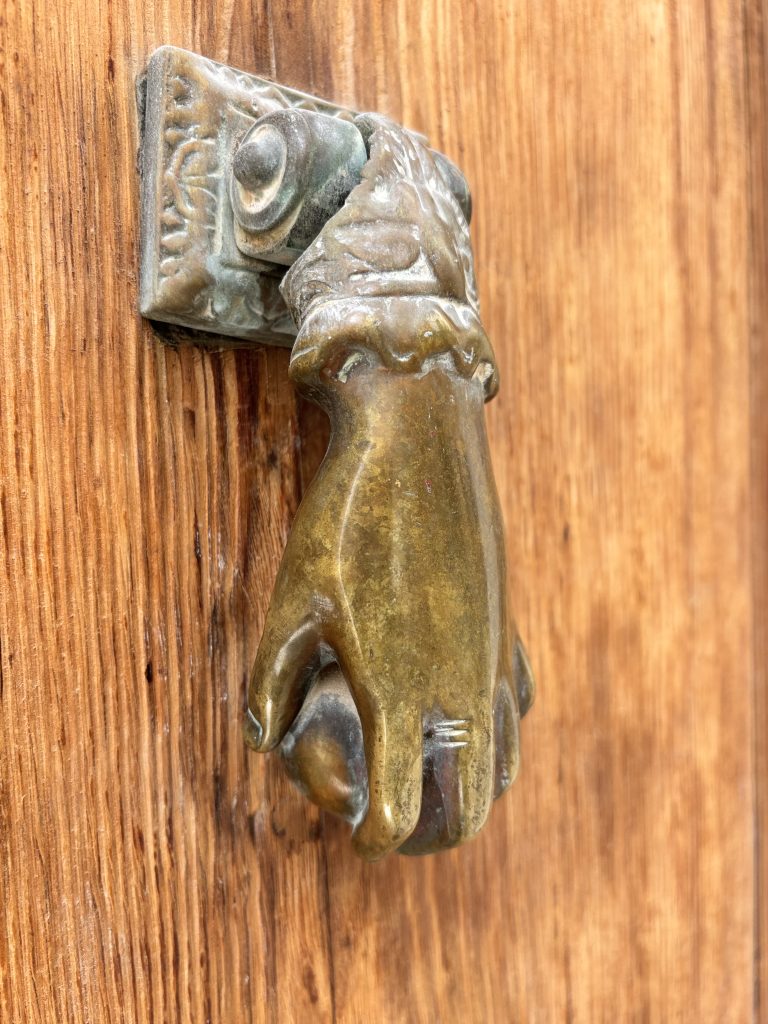
The ball-in-hand knocker in Xàbia’s Old Town is the same object, two thousand years later, still on the same kind of door. Enough of them to notice the pattern, varied enough to reward looking closely. From the simplest iron ring to elaborate decorated bronze, the full historical range is visible in a single walk. You stop noticing them after a while, which is exactly what happens to things that have been in the same place for centuries.
Origins
The door knocker as a functional object is ancient. Greek and Roman households used metal rings mounted on door plates to announce visitors, and archaeological examples survive from Pompeii and across the Roman Mediterranean. The hand form specifically appears in Roman contexts, the hand of a god, or of authority, rendered in metal as both functional object and symbolic statement.
The closed fist gripping a ball or bar carried specific meaning. In Roman iconography it represented power, legal authority and protection. A hand mounted on a door was not just a simple mechanism for knocking. It was a statement about the household behind it, that it was protected, that it had standing, that the person inside was someone of consequence.
The Islamic Tradition
The hand carried a different but related meaning in Moorish Spain.
The Hand of Fatima, named after the daughter of the Prophet Muhammad was one of the most widely used protective symbols across North Africa and Al-Andalus. The hamsa, as it is also known, was believed to ward off the evil eye and keep the home and its occupants safe. Mounted on a door it announced that the household was under divine protection. The symbol predates Islam, appearing in Jewish tradition as the Hand of Miriam, sister of Moses and in various forms across the ancient Mediterranean. Islam absorbed it and Moorish Spain carried it into the Iberian peninsula where it took root in domestic architecture in a way it has never entirely left. And that is evident today.
The Reconquista transferred the territories but not the traditions. Christian households in the newly recovered towns of Valencia and Murcia continued using the same craftsmen and the same styles. The protective symbolism of the hand was too deeply embedded in domestic culture to be totally erased by a change of faith.
Gender and the Two Knockers
The most practically interesting detail of the tradition is almost never mentioned.
In traditional Muslim households it was considered inappropriate for a woman to open the door to a male visitor. Wealthier homes addressed this with two distinct knockers on the same door: a smaller, lighter hand for female visitors and a larger, heavier one for male visitors. Each produced a different sound when struck. The women inside could hear the difference and know whether it was safe to answer the door themselves or whether a male member of the household should respond.
The social architecture of the household was literally built into the door furniture. You announced not just your presence but your gender before anyone inside had to make a decision about opening the door.
Examples of paired knockers survive across the former territories of Al-Andalus. Whether the Old Town of Xàbia ever had paired knockers on its doors is not documented but the tradition was widespread enough in Moorish Valencia that the absence of evidence is not evidence of absence!
The Symbol of Hospitality
As the form spread through the Mediterranean and later into the Spanish colonial world, the hand and ball shed some of its protective and social function and acquired a new one. The ball-in-hand became a symbol of hospitality, of welcome, of a household that received visitors properly. The meaning shifted from protection to invitation without the form changing at all.
That layering of meanings, Roman authority, Islamic protection, gendered social code, Mediterranean hospitality, is what makes the ball-in-hand knocker more interesting than it first appears. It is not a decorative choice. It is an object that has accumulated much significance across two thousand years and multiple cultures and ended up on the doors of a small medieval town on the Valencian coast where it has been knocking ever since.
The Craft
The earliest examples were cast in iron using lost-wax or sand casting techniques that had changed little since Roman times. The hand form required a skilled pattern maker, the anatomy had to be convincing enough to read clearly at door height, the proportions balanced so the piece hung correctly and struck with the right weight and sound.
Brass and bronze examples appear from the 16th century onward, particularly on more prosperous households. The material allowed finer detail, more elaborate backplates, decorative cuffs at the wrist, occasional figural elements incorporated into the design. The sound was different too: brass on iron striker plate produces a higher, carrying note than iron on iron.
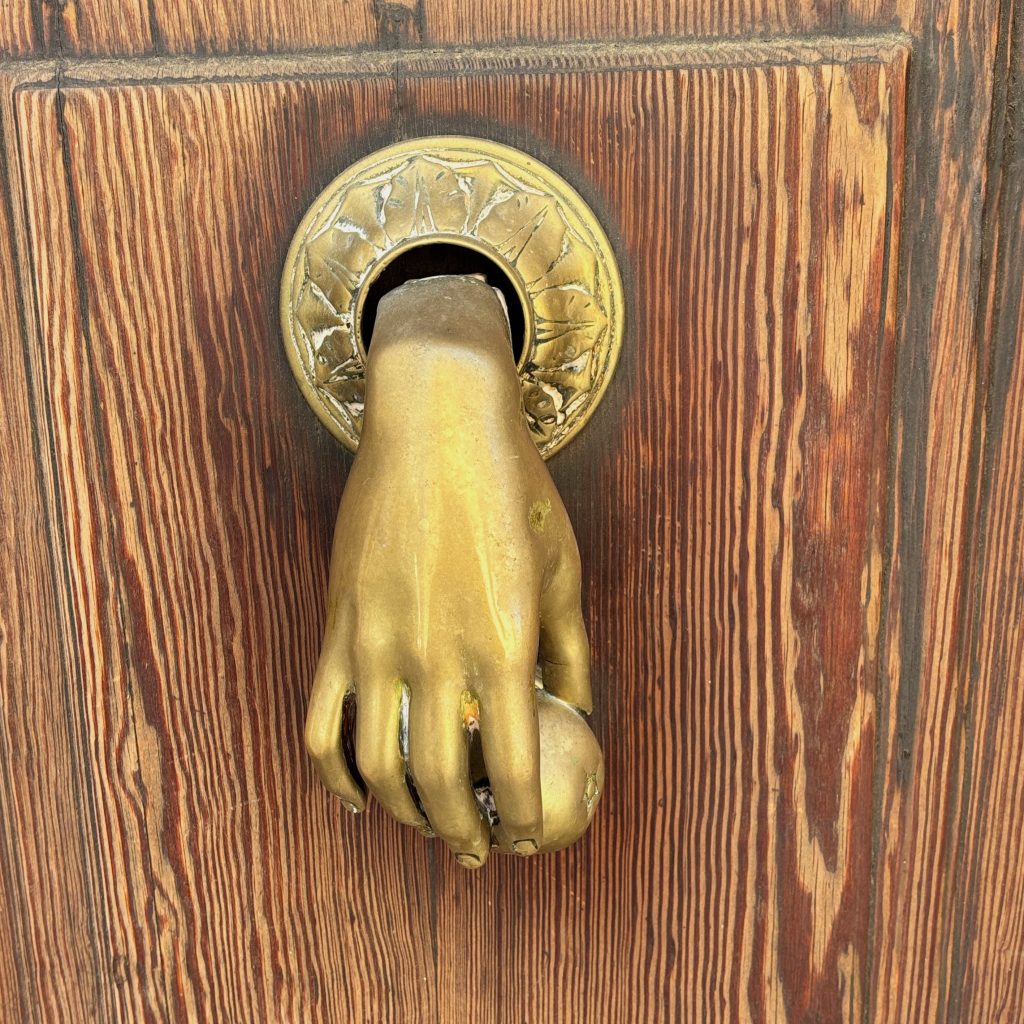
The backplate serves both structural and decorative functions. It distributes the fixing load across the door surface and protects the wood from the repeated impact of the knocker. The simplest are plain rectangles or ovals. The most elaborate incorporate coats of arms, religious imagery, foliate decoration and architectural motifs. Reading the backplate of a door knocker in the Old Town tells you approximately when it was made, who made it and something about the wealth of the household that commissioned it.
What the Wear Tells You
The patina on an old door knocker is not dirt. It is use. The high points of the casting, the knuckles, the ball, the striking face, wear to a brightness that no polish produces because the brightness comes from thousands of hands gripping the same surface in the same way over the centuries. The recesses accumulate oxidation that darkens the iron or greens the brass. The contrast between the two is the record of how the object has been used. You can see this throughout the Old Town.
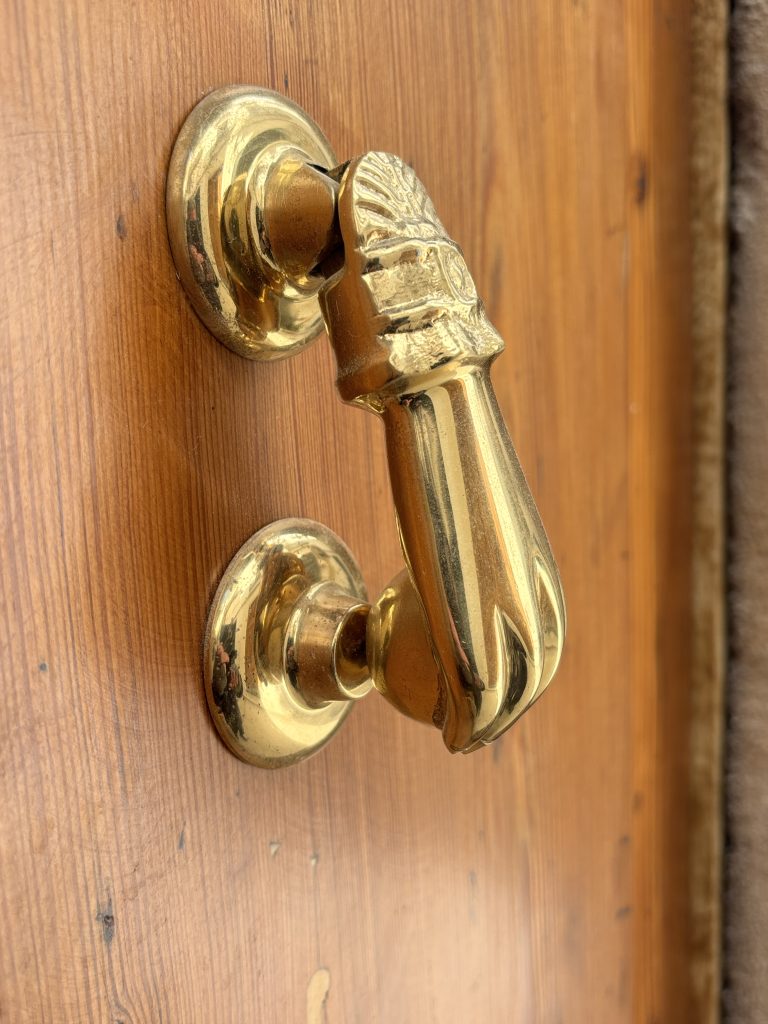
The fixing points tell a different story. Where iron screws or bolts have held the backplate to the door for a century or more, the metal has bled into the surrounding wood and stone, leaving staining that outlines the plate even when the plate is gone. Several doors in the Old Town show the ghost of a knocker that was removed or replaced, the stain of the original still visible in the Tosca surround.
What Survived and What Didn’t
The Civil War destroyed a great deal of the moveable heritage of the Valencian Old Towns, artworks, documents, furniture, metalwork. Door knockers, being fixed to the fabric of the building and having no obvious ideological significance, largely survived. The ones on the doors of the Old Town today are predominantly original to the buildings or to early restoration work. The replacements are usually obvious, too bright, wrong period, wrong weight.
A few doors have acquired modern reproductions that are technically competent but wrong in the way that reproductions are always wrong. They have the form without the history. The hand is correct but the hand has never been used to make it something that only thousand of hands can produce.
The Ball-in-Hand Today
The tradition is no longer a living craft in any commercial sense. The foundries that produced door furniture for Valencian households throughout the 19th and early 20th centuries are long gone. Reproduction pieces are available but they are not quite the same and you can spot them from a distance.
What remains are the knockers themselves, still on the doors they were made for. The foundries are gone. The craftsmen are gone. The knockers are still there. Still knocking!
The door knockers themselves are photographed in Door Knockers. The doors they are mounted on are in Doors. The wear patterns they leave on stone surrounds are in Wear.